knowledge-centric-ai
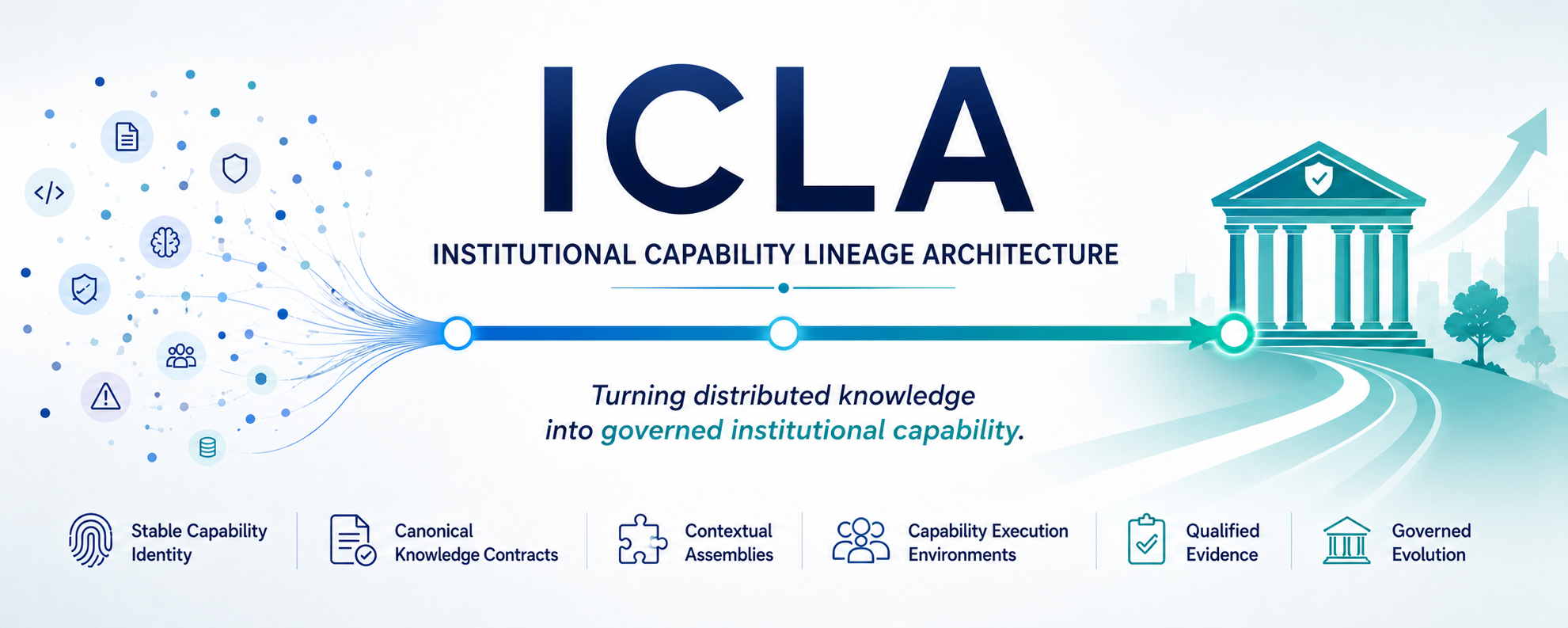
Institutional Capability Lineage Architecture (ICLA)
Companion repository for the paper:
Institutional Capability Lineages: A Registry-centered Reference Architecture for Governed and Evolving AI
SSRN preprint — DOI: 10.2139/ssrn.7172438
Author
Mariano Garralda-Barrio
Institutional Capability Lineage Architecture (ICLA) is a reference architecture for preserving the continuity of recurring institutional capabilities across changing people, agents, models, workflows, systems, and infrastructures.
The public paper is identified by DOI 10.2139/ssrn.7172438. Reviewer companion packages intentionally omit the manuscript; the reviewed version is supplied through the corresponding submission channel. The specification, reference trace, and executable companion track the refined conceptual model and conformance boundaries being prepared for its successor.
ICLA addresses a problem that sits above retrieval, memory, context engineering, and agent orchestration:
How can an institution keep a capability authoritative, executable, traceable, and evolvable when knowledge and execution are distributed?
The architecture separates distributed execution and knowledge production from institutional authority. Humans, AI agents, workflows, software systems, and hybrid environments may reason and act locally, while capability identity, canonical contracts, evidence disposition, and institutional evolution remain governed, traceable, and auditable.
The Missing Question
Current AI systems continue to improve at execution.
Retrieval-Augmented Generation (RAG), agent memory, context engineering, skills, multi-agent systems, and interoperability protocols all help humans and AI systems perform increasingly complex work.
Yet organizations depend on something that none of these mechanisms guarantee on their own:
Who preserves organizational capability when people, agents, models, workflows, and platforms change?
ICLA is designed to answer that institutional question. Rather than improving execution itself, it introduces an architectural layer that preserves capability identity, authoritative knowledge, governed evolution, and institutional continuity across heterogeneous execution environments.
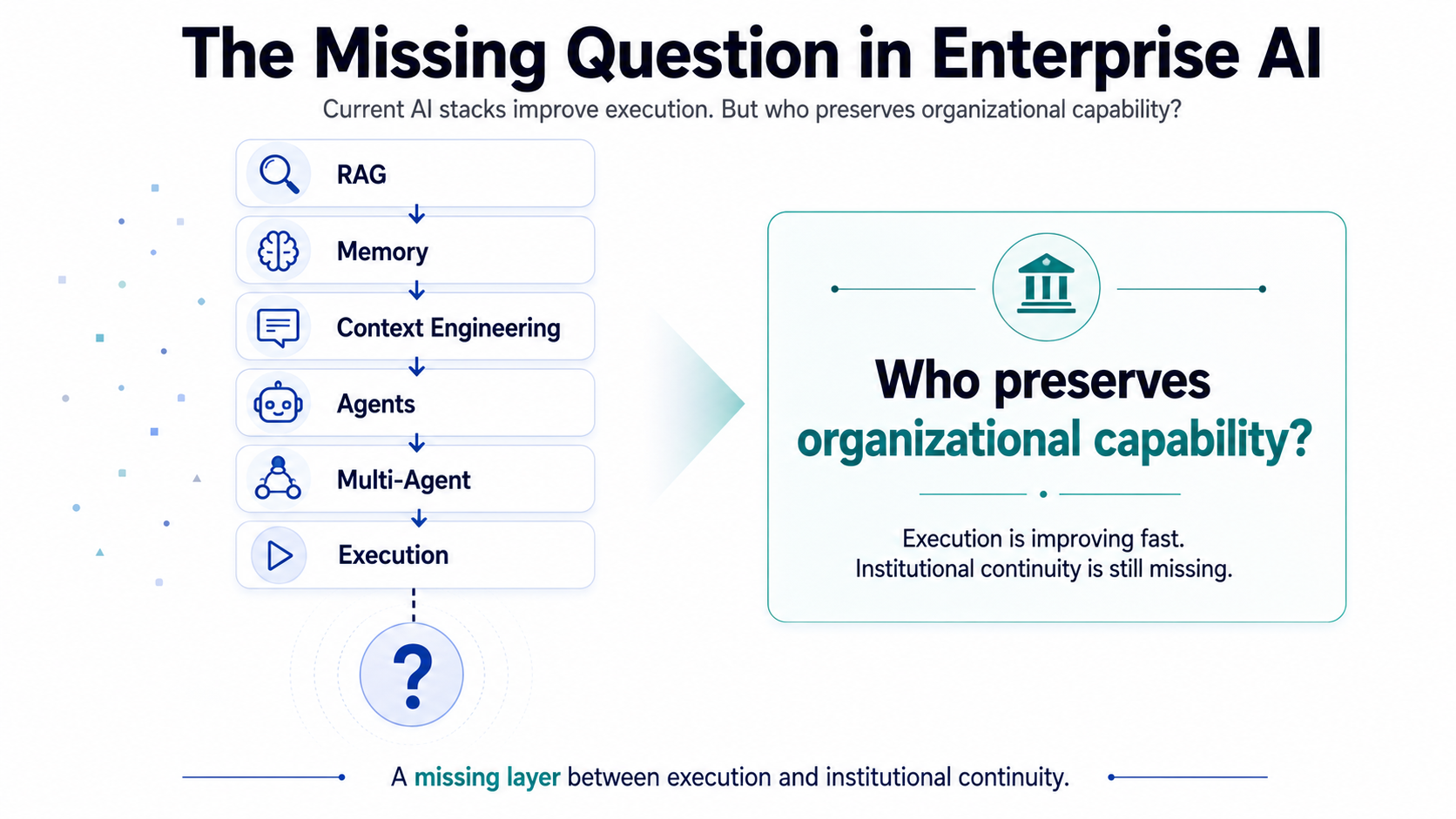
Figure 1 — Current AI stacks continuously improve execution. ICLA addresses the missing institutional layer required to preserve organizational capability over time.
Quick links: SSRN preprint · Citation · Changelog · Conformance coverage · Schemas · Reference objects · Reference traces · Reference implementation
Why ICLA Exists
Current AI stacks are increasingly effective at retrieval, context construction, memory, tool use, coordination, and execution. These mechanisms improve what a system can do at runtime, but they do not by themselves guarantee:
- stable institutional capability identity;
- a canonical and versioned knowledge contract;
- governed derivation of execution-specific context;
- qualified evidence linked to the execution that produced it;
- continuity across changing people, models, agents, workflows, and systems.
ICLA introduces an institutional architecture layer that connects these responsibilities without replacing the execution technologies beneath it.
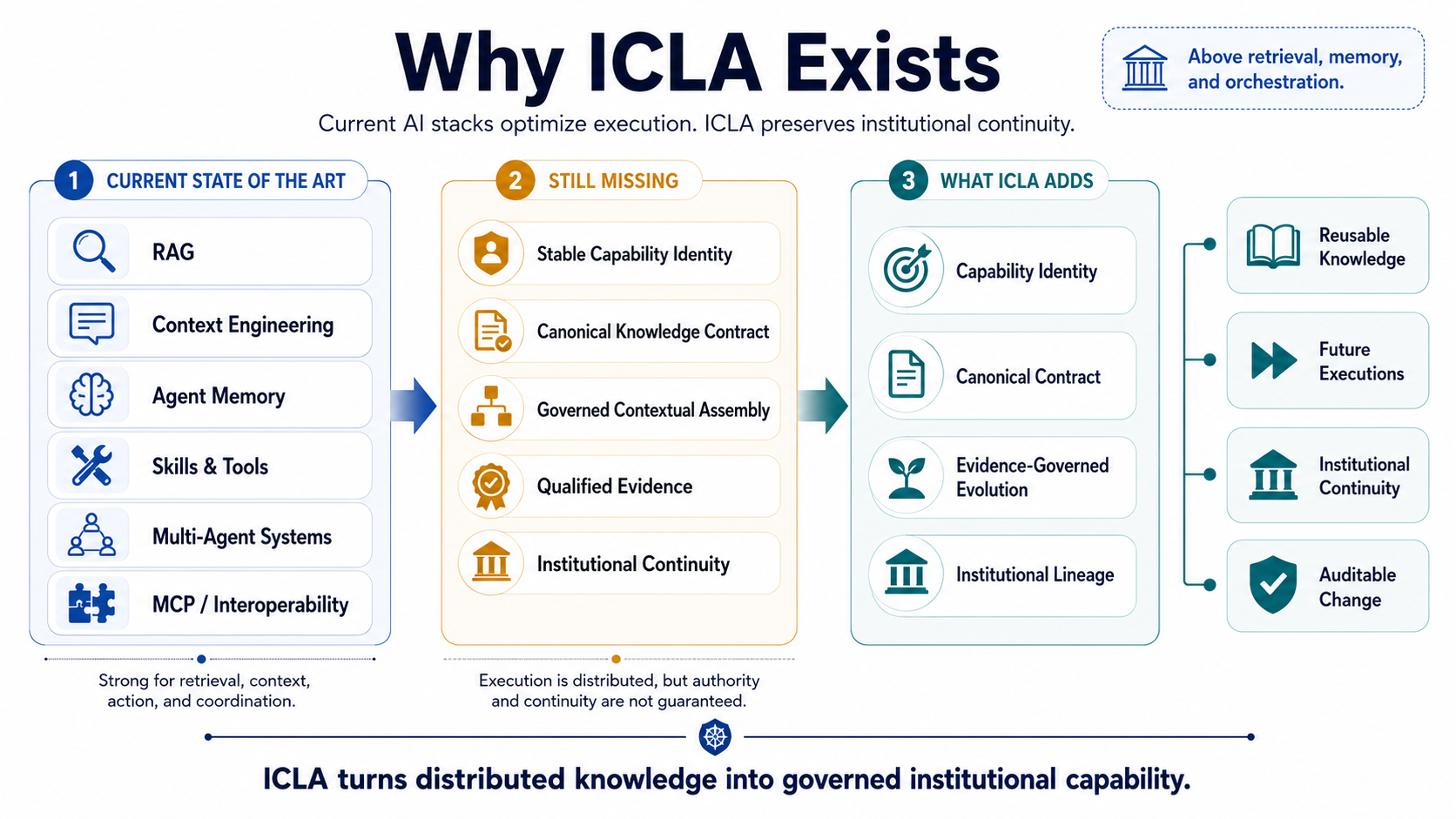
Figure 2 — Why: the current execution stack, the institutional gap, and the architectural responsibilities introduced by ICLA.
Core Thesis
ICLA makes the institutional capability lineage the primary architectural unit of continuity.
In this repository, ICLA names the reference architecture, an institutional capability lineage is its modeled authority-preserving relational structure, and a lineage trace is one concrete retained instantiation for a capability and its executions.
A lineage connects:
- a stable institutional capability identity;
- active and historical Capability Knowledge Contracts;
- intent resolutions and contextual assemblies;
- Capability Execution Environments;
- execution evidence and measurements;
- governance decisions;
- successor activation and lifecycle changes.
Neither a Registry nor a Capability Knowledge Contract preserves this continuity in isolation. The lineage connects what must persist with what must adapt.
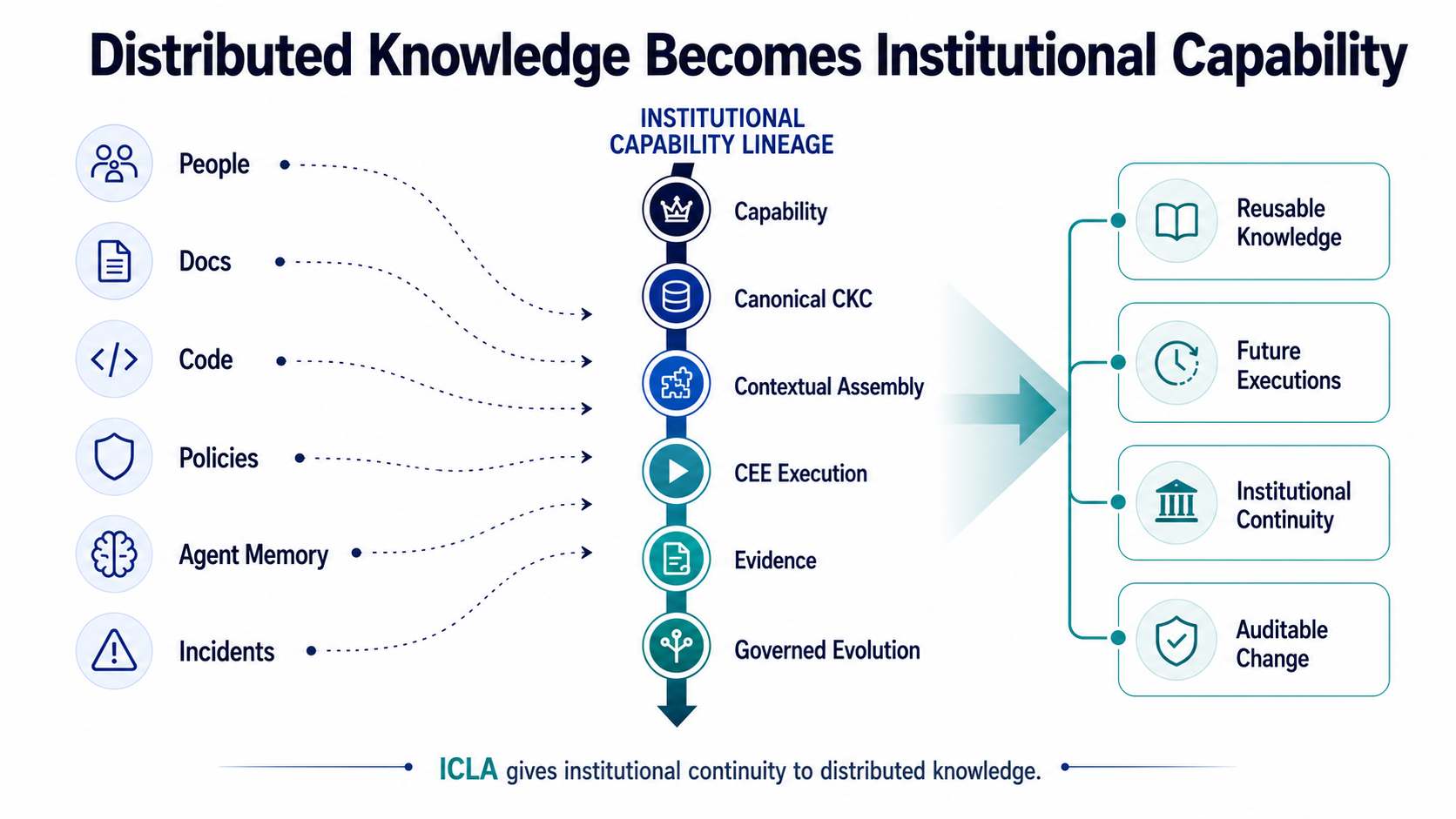
Figure 2 — What: distributed organizational knowledge becomes reusable institutional capability through a governed lineage.
ICLA at a Glance
| Architectural question | ICLA answer |
|---|---|
| What persists across changing execution mechanisms? | Institutional capability identity and its lineage. |
| What is authoritative? | The active, versioned Capability Knowledge Contract. |
| What is execution-specific? | The contextual assembly and local CEE state. |
| Who may execute? | Humans, agents, workflows, services, or hybrid environments. |
| What may justify future institutional change? | Qualified evidence may inform governance; only an authorized activation changes the active institutional state. |
| How does the architecture evolve? | Through explicit successor activation or capability crystallization. |
Architecture Overview
The main architectural flow is:
- Registry — resolves stable institutional capability identity, ownership, lifecycle, relations, and the active CKC.
- Canonical CKC — defines the authoritative, versioned, consumer-independent knowledge and evaluation contract.
- Contextual Assembly — records an immutable, bounded operational mandate over exact CKCs, governed sources, evidence, and evaluation contracts.
- CEE — executes autonomously within that mandate using local reasoning, working state, tools, coordination, and iteration.
- Evidence — returns only contract-selected outputs and checkpoints while preserving provenance, assembly identity, applicable contracts, and any versioned transformation used to construct the submitted report.
- Governance — qualifies and adjudicates candidate institutional knowledge.
- Successor — activates a new CKC version for future resolutions while preserving historical state.
The Institutional Capability Lineage spans the complete lifecycle rather than appearing as a final repository or isolated audit trail.
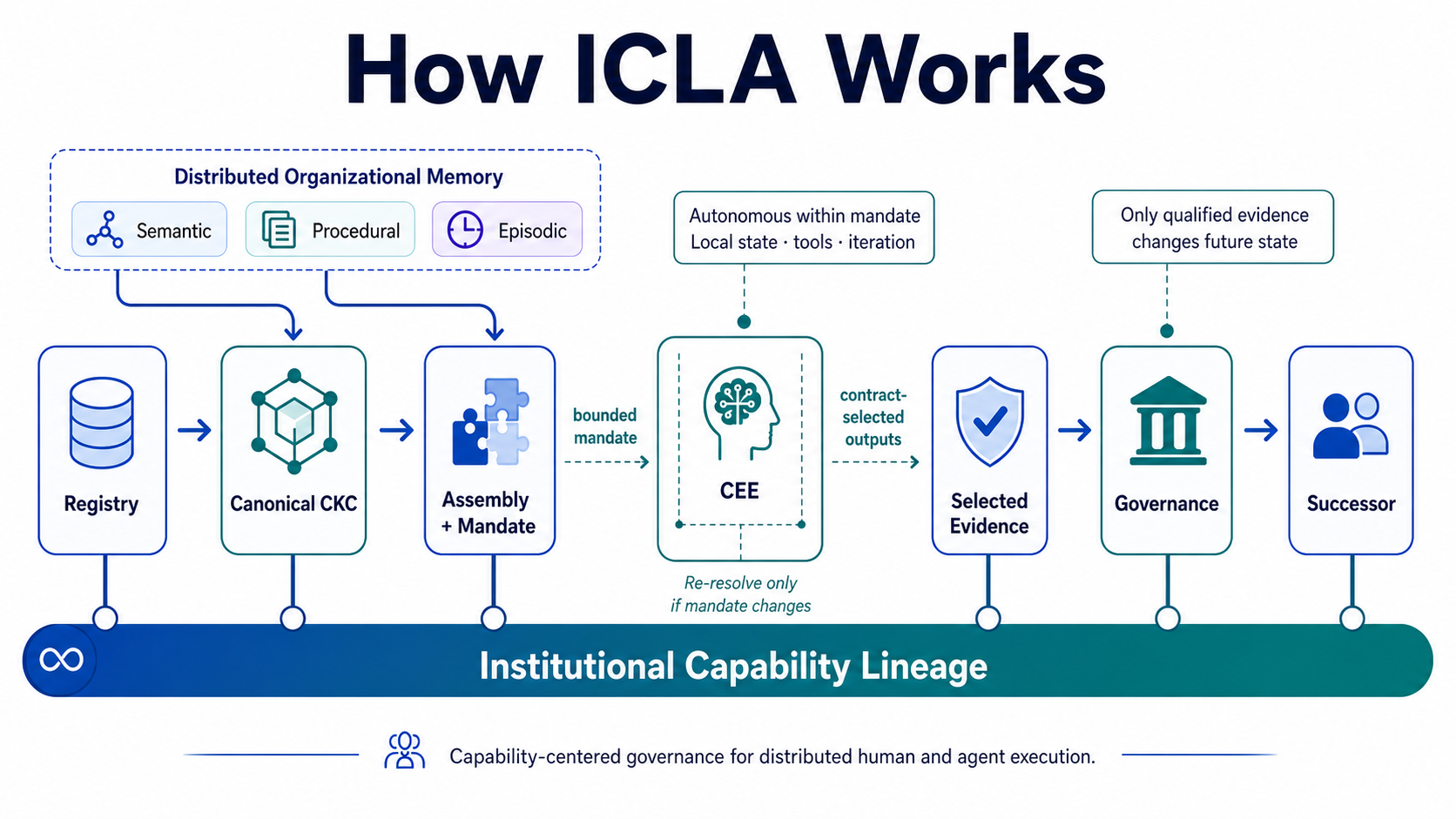
Figure 3 — How: governed organizational memory becomes a bounded mandate, the CEE executes autonomously within it, and contract-selected evidence returns through an auditable lineage.
Architectural Positioning
ICLA does not replace RAG, agent memory, context engineering, skills, multi-agent orchestration, or interoperability protocols.
Those mechanisms primarily operate at execution time:
- RAG retrieves information for a request.
- Context engineering constructs execution context.
- Agent memory supports local continuity.
- Skills and tools provide executable actions.
- Agent runtimes reason, act, and coordinate.
- MCP and other protocols provide interoperability.
- ICLA governs which institutional capability is responsible, which contract is authoritative, how execution views are derived, and how qualified evidence may justify governed changes to future institutional state.
ICLA therefore operates at the institutional architecture layer around heterogeneous human and machine execution. Retrieval, orchestration, planning, memory updates, and tool use may occur inside the assembly or CEE; ICLA is not part of their step-wise execution loop.
Key Architectural Objects
Organizational Memory
ICLA treats organizational memory as versioned knowledge distributed across documents, code, policies, decisions, data, approved interpretations, observations, and evidence.
Its contents may play overlapping functional roles:
- semantic — concepts, policies, models, and approved interpretations;
- procedural — methods, controls, workflows, and executable practices;
- episodic — prior executions, decisions, exceptions, incidents, and evidence.
These roles describe how governed knowledge functions for a capability. They are not storage layers, and one source may support several roles. Source owners retain content authority while CKCs govern bindings and projection into capability execution.
Institutional Capability
A recurring, outcome-oriented institutional responsibility with:
- a stable identity;
- accountable ownership;
- lifecycle state;
- typed relations;
- an active Capability Knowledge Contract.
Institutional Capability Registry
A navigable institutional address book that manages:
- capability identity;
- ownership and lifecycle;
- typed capability relations;
- risk, policy, and applicability metadata;
- pointers to active CKC versions;
- lineage and impact paths.
The Registry indexes distributed knowledge through governed bindings rather than duplicating source content.
Capability Knowledge Contract
A Capability Knowledge Contract (CKC) is the canonical, versioned, consumer-independent contract for the knowledge and evaluation commitments required to perform a capability.
A CKC defines:
- knowledge scope and source bindings;
- obligations and operational relations;
- evidence schemas;
- evaluation contracts;
- governance and authority;
- projection and assembly rules.
CKC scope and source bindings may cover semantic commitments, procedural guidance, and episodic precedents without requiring separate CKC partitions.
Canonicality is an authority property, not a storage topology.
Contextual Assembly
A contextual assembly is an immutable, intent-specific projection of active CKCs and governed sources for a particular execution context.
It records:
- exact source and CKC versions;
- selections and exclusions;
- provenance;
- evaluation contracts;
- delivery and applicability constraints.
An assembly may combine semantic commitments from policies, procedural guidance from governed practices, and episodic knowledge from prior incidents or evidence.
The assembly correctness trace records how RequiredCovered was assessed and
pins the applicable validator, model, or review-policy version. This preserves
auditability without requiring every assessment method to be deterministic.
Admission turns the assembly into a bounded operational mandate. It delegates execution-scoped authority to the identified CEE while explicitly withholding institutional or canonical change authority. The mandate remains valid without repeated Registry interaction until intent, coverage, authority, freshness, risk, or assurance changes materially.
Materialization may deliver a bundle, payload, workspace, procedure, or governed access handle. Every form must preserve the assembly’s exact versions, limits, evidence contract, and lineage.
Capability Execution Environment
A Capability Execution Environment (CEE) is the situated, execution-scoped boundary that performs an admitted capability instance. Its record pins the configuration attributes needed for resolution, authorization, assurance, traceability, and evidence interpretation; stable institutional identity remains with the capability lineage.
A CEE may be:
- a human or team;
- an AI agent;
- a multi-agent configuration;
- a workflow;
- a software service;
- a hybrid environment.
Through a contextual assembly, a CEE consumes authorized semantic commitments, procedural guidance, and episodic precedents. Within the admitted mandate it controls reasoning, planning, working memory, local stores, tools, intermediate artifacts, coordination, and iteration without step-wise ICLA interaction.
A CEE may produce situated observations, interpretations, artifacts, practices, decisions, measurements, and execution records. Those outputs remain candidate organizational knowledge until they pass through an identified source or evidence path.
Production, recurrence, or technical success does not grant institutional authority automatically.
Governed Evidence and Evolution
Only terminal or contract-defined checkpoint outputs return through the identified evidence path, with their execution identity, assembly, applicable contracts, and provenance intact. If a versioned transformation is used to construct the submitted report, its identifier and version remain in that provenance; no transformation reference is required when none was used. Conformance does not require disclosure of internal reasoning or working state beyond the evidence contract.
A submitted evidence bundle creates an episodic lineage record and presents reusable lessons as candidate knowledge. After qualification and adjudication, governance may:
- reject or quarantine the evidence;
- retain it locally;
- preserve it as an institutional precedent;
- refresh governed source bindings or projection rules;
- authorize a successor CKC;
- initiate capability crystallization.
A local execution never mutates canonical institutional state directly. Schema conformity does not establish substantive correctness or evidential sufficiency. Likewise, impact propagation identifies what requires assessment; it does not invalidate a CKC or block admission unless an applicable policy or governed decision makes the affected state inadmissible.
Maintenance events may be reviewed concurrently, while canonical succession remains ordered. A successor can be appended only from the latest appended CKC; a stale predecessor is rejected without creating a canonical branch or moving the active pointer.
Capability Crystallization
Capability crystallization is the governed formation of a new institutional capability from a recurrent responsibility supported by retained history and an authorized institutional review.
Detection may yield no proposal, one proposal, or several independent proposals. Ranking can prioritize this set, but it does not discard candidates or grant institutional authority.
It is distinct from extending the CKC lineage of an existing capability:
- successor activation evolves an existing capability;
- crystallization establishes a new institutional capability identity.
Scientific Contribution
The primary contribution is a Registry-addressable institutional capability lineage model that makes the following jointly accountable:
- stable capability responsibility;
- canonical capability contracts;
- contextual execution;
- comparable evidence;
- governed institutional evolution.
Supporting contributions include:
-
Contract–projection separation
CKCs remain canonical and consumer-independent; contextual assemblies and local execution state remain derived. -
Distributed execution with governed authority
CEEs may reason, act, and produce situated knowledge locally without gaining authority to mutate institutional state. -
Evidence-governed evolution
Each decision links the predecessor, a complete immutable successor CKC, and an authorized delta containing the changed commitments, rationale, supporting evidence, authorizing decision, and rollback reference. Activation affects only future resolutions. -
Succession–crystallization separation
Incremental evolution of an existing capability is distinguished from the governed emergence of a new capability. -
Executable architectural specification
The paper is accompanied by schemas, reference objects, linked traces, conformance profiles, a deterministic implementation, and executable tests.
Research method and evidentiary boundary
ICLA is developed as an iterative design-science artifact. The responsibility-oriented literature synthesis examines, refines, positions, and justifies the artifact’s objectives and protected boundaries; it is not presented as a one-pass derivation from literature to implementation. The requirement-to-component mapping records traceability among the identified problem, relevant literature, architectural requirements, and the resulting artifact.
The OAuth 2.1 trace is a constructed demonstration. Schemas, linked records, deterministic replay, negative tests, and invariant checks provide formative and summative artificial evaluation of structural consistency and technical feasibility within the declared scope. The comparative longitudinal protocol is prospective, and independent organizational validation remains future work.
Repository Contents
| Path | Purpose |
|---|---|
citation.bib |
BibTeX citation entry. |
CITATION.cff |
GitHub-compatible citation metadata. |
CHANGELOG.md |
Public record of companion-artifact changes. |
figures/ |
README and publication figures. |
specification/conformance-matrix.md |
Coverage and evidentiary mapping from ICLA-1–ICLA-11 to machine-checkable clauses, supporting artifacts, executable tests, and governed-judgment remainders. |
specification/schemas/ |
Machine-checkable JSON Schema contracts for the principal ICLA object types. |
specification/reference-objects/ |
Consumer-independent reference objects and schema mappings. |
specification/reference-traces/ |
Linked reference traces for the implemented lifecycle scope and prospective governed branches. |
specification/reference-traces/oauth-042/ |
OAuth 2.1 trace covering pre-resolution source impact, resolution, assembly, evidence, governance, activation, and historical preservation. |
specification/reference-traces/auth-evolution-formation/ |
Submitted-proposal trace covering governed identity formation, initial CKC v1 append, inactive state, and separate initial activation. |
reference-implementation/ |
Deterministic, schema-driven implementation of resolution, evidence governance, CKC succession, capability formation, activation, and lineage preservation. |
reference-implementation/tests/ |
Executable checks for both governed evolution paths, negative boundaries, historical immutability, and connected lineage. |
Reference Artifact Set
The companion artifact set is versioned as icla-spec 0.1.0 and includes machine-checkable contracts for:
- institutional capability;
- pre-institutional capability proposal;
- Capability Knowledge Contract;
- Registry snapshot;
- intent;
- resolution and admission;
- contextual assembly;
- evidence bundle;
- governance decision and activation.
The paper defines the architecture and conformance requirements. The companion artifacts serve distinct scientific roles:
- Meta-model and invariants establish structural consistency.
- Schemas and linked reference records establish representational consistency.
- Reference traces establish end-to-end traceability and reproducibility.
- Reference implementation and tests establish executable consistency from resolution through successor activation and for the bounded governed capability-formation transition.
- Conformance coverage matrix maps each invariant to the available evidence and preserves the remainder that requires governed judgment; it is not a score or certification dashboard.
- Claims C1–C3 define the comparative evaluation still required to assess effectiveness.
The schemas, traces, and implementation do not introduce additional architectural requirements beyond the paper’s conformance invariants.
OAuth 2.1 Reference Trace
The oauth-042 trace exercises the implemented resolution-to-succession lifecycle and represents the separate crystallization proposal branch without promoting it.
It includes:
- the pre-resolution identity-policy impact path from
CHG-IDENTITY-POLICY-008throughCAP-IAM,DEC-IAM-008, andACT-IAM-008, with a retained assembly still linked toCKC-IAM v7; - intent generation by a composite CEE;
- Registry resolution and admissibility;
- selection of six exact CKC versions;
- contextual assembly;
- agent and human-review materializations;
- governed evidence and contract-defined measurements;
- evidence qualification and adjudication;
- activation of
CKC-VERIFY v10for future resolutions; - preservation of earlier executions linked to
v9; - a separate capability-crystallization proposal path.
The executable suite replays the same identifiers and verifies the
pre-resolution IAM impact path, conformance, activation, historical
immutability, and connected lineage. OAuth intentionally does not assign
CAP-AUTH-EVOL; one execution is insufficient to establish recurrence.
The separate
auth-evolution-formation
trace begins with a submitted proposal supported by multiple retained signals.
It executes authorized formation of CAP-AUTH-EVOL and complete
CKC-AUTH-EVOL v1, retains the intermediate no-pointer state, and performs
initial activation separately. This validates the transition structure, not
automatic discovery or the institutional quality of the proposal.
Conformance Profiles
ICLA defines three cumulative profiles:
| Profile | Purpose |
|---|---|
| ICLA-Core | Stable capability identity, Registry navigation, CKCs, contextual projection, CEE traceability, and reproducibility. |
| ICLA-Governed | ICLA-Core plus governed evidence, measurement conformity, successor creation, and activation. |
| ICLA-Evolving | ICLA-Governed plus ICLA-11 and the governed capability-formation boundary. The companion executes the submitted-proposal formation path; discovery quality and institutional judgment remain outside machine assessment. |
Conformance is behavioral and implementation-independent. Every conformance result must state both the named profile and its assessment scope. The conformance coverage matrix records the available machine-checkable evidence and the governed-judgment remainder without assigning a score or certification status.
Scope and Non-Goals
ICLA is designed for recurring institutional work that is:
- heterogeneous;
- auditable;
- volatile;
- high-impact;
- distributed across humans and machines;
- dependent on continuity across changing execution mechanisms.
The architecture is independent of:
- database technology;
- model provider;
- agent framework;
- coordination topology;
- transport protocol;
- knowledge serialization format.
An implementation may use relational databases, graphs, object storage, REST, MCP, files, messaging, or other mechanisms, provided that the conformance invariants are preserved.
This repository is not:
- an enterprise knowledge platform;
- a replacement for source systems;
- an agent framework;
- a complete production governance system;
- evidence of comparative production effectiveness.
What This Repository Demonstrates
This repository demonstrates:
- structural consistency;
- linked reference representations;
- deterministic execution of the reference trace;
- conformance validation;
- governed successor activation;
- preservation of historical state;
- a connected lineage trace instantiating the institutional capability lineage.
It does not yet demonstrate comparative effectiveness in production environments.
The paper defines a longitudinal evaluation protocol for measuring:
- cross-CEE canonical stability;
- continuous change accountability;
- controlled institutional capability discovery;
- governance cost;
- task quality and assurance.
Intended Audience
This repository is intended for:
- researchers studying knowledge-centric AI and institutional AI systems;
- software, data, and enterprise architects;
- designers of agentic and human–agent platforms;
- governance, assurance, and risk teams;
- implementers evaluating ICLA conformance;
- organizations exploring capability-centered knowledge architectures.
Citation
When using this work in research, architecture analysis, or implementation, please cite the current preprint:
Garralda-Barrio, M. (2026). Institutional Capability Lineages: A Registry-centered Reference Architecture for Governed and Evolving AI. SSRN preprint. https://doi.org/10.2139/ssrn.7172438
Machine-readable metadata is available in citation.bib and
CITATION.cff:
# See citation.bib or use GitHub's "Cite this repository" control
License
The paper and accompanying documentation are licensed under the:
Creative Commons Attribution 4.0 International License (CC BY 4.0)
The reference implementation and executable code are licensed separately under the:
MIT License
Status
| Area | Status |
|---|---|
| Architecture | Defined |
| Conformance invariants | Defined |
| Conformance coverage matrix | Available |
| Companion schemas | Available |
| Reference objects and trace | Available |
| Deterministic reference implementation | Available |
| Executable tests | Available |
| Governed capability-formation transition | Available |
| Automatic discovery and organizational evaluation | Future work |
| Comparative longitudinal evaluation | Future work |