knowledge-centric-ai
OAuth 2.1 Reference Artifact Trace
This directory serializes the OAUTH-042 worked example from Institutional
Capability Lineage Architecture. Each file represents one governed object in
the execution trace and links to the identifiers produced by the preceding
step.
These artifacts target icla-spec: 0.1.0 and validate against the draft
schemas in schemas/. Both the instances and the
schemas remain non-normative at this stage.
Pre-resolution IAM impact path
Before INT-OAUTH-042, identity-policy change
CHG-IDENTITY-POLICY-008 revises the source’s authorized interpretation and
temporal applicability. The Registry snapshot preserves the complete,
inspectable path without introducing another principal artifact type:
CHG-IDENTITY-POLICY-008
        -> BIND-IDENTITY-POLICY
        -> IMP-IAM-008
        -> CAP-IAM + its Registry relation neighborhood
        -> DEC-IAM-008
        -> DELTA-IAM-007-008
        -> CKC-IAM v8 / APPEND-IAM-008 (inactive)
        -> ACT-IAM-008

ASM-IAM-HIST-007 remains linked to CKC-IAM v7
The impact record identifies the affected binding, exact CKC versions, six
relation-connected capabilities, and every traversed Registry edge. Only
CAP-IAM changes canonical state; the other capabilities are identified for
impact review and remain unchanged. Activation applies to future resolutions,
which is why REG-SNAP-042 and ASM-OAUTH-042 subsequently select
CKC-IAM v8 while the retained historical assembly still points to v7.
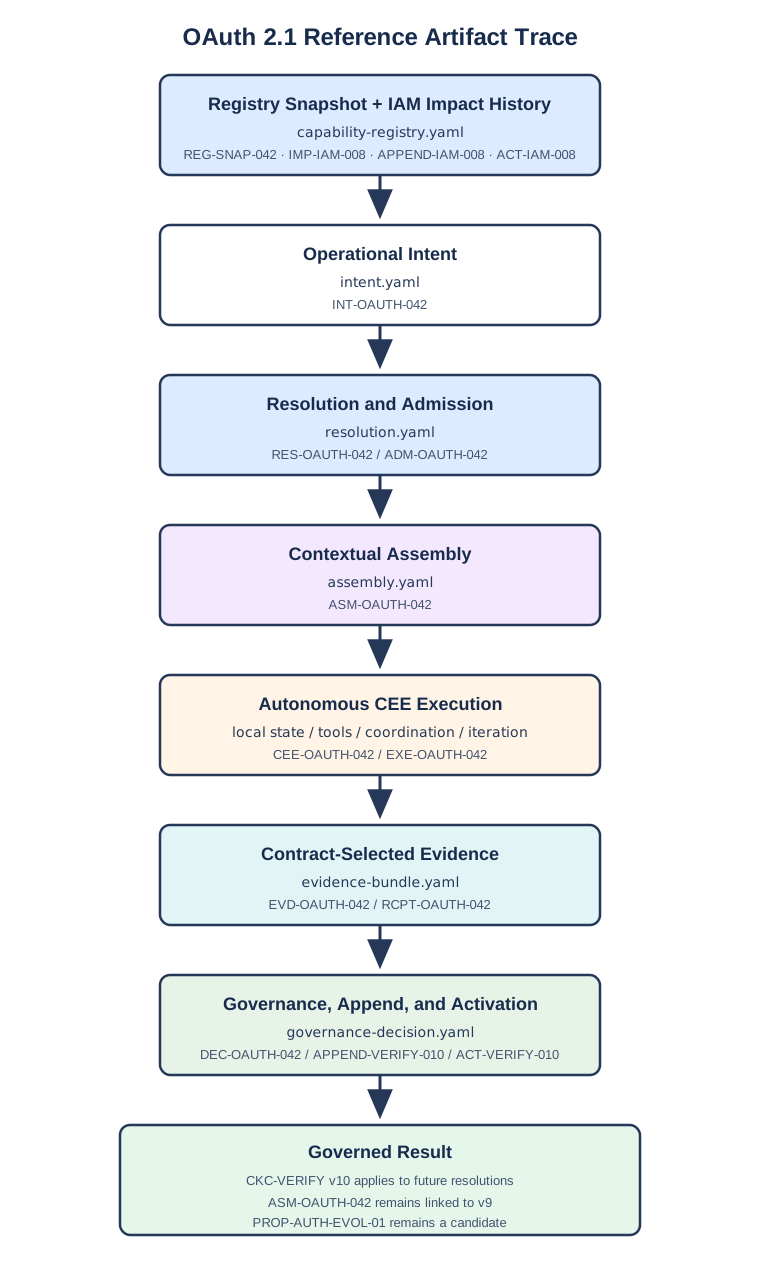
Object Graph
REG-SNAP-042
      │
      ▼
INT-OAUTH-042
      │
      ▼
RES-OAUTH-042 / ADM-OAUTH-042
      │
      ▼
ASM-OAUTH-042
      ├──> MAT-AGENT-042 ──┐
      └──> MAT-REVIEW-042 ─┤
                           ▼
EVD-OAUTH-042 / RCPT-OAUTH-042
      │
      ▼
DEC-OAUTH-042 / APPEND-VERIFY-010 (inactive) / ACT-VERIFY-010
      │
      ▼
CKC-VERIFY v10 (future resolutions)
Trace
- Registry Snapshot —
REG-SNAP-042records capability identities, relations, owners, active CKC pointers, and the pre-resolutionCAP-IAMimpact and activation history described above. - Intent —
INT-OAUTH-042declares the OAuth 2.1 goal, situated boundaryCEE-OAUTH-042, configurationCEE-CONFIG-OAUTH-042, consumer, risk, budget, constraints, and required assurance. - Resolution —
RES-OAUTH-042navigates the Registry, expands mandatory relations, excludes inapplicable capabilities, resolves the compatibility conflict, retains matcher identity/version and explicitly non-calibrated qualitative confidence semantics, and produces theadmittedoutcomeADM-OAUTH-042with a nonempty exact active-CKC map. - Assembly —
ASM-OAUTH-042snapshots six exact CKC versions, selects and excludes knowledge, binds governed metrics, and records the deterministicRequiredCoveredmethod and validator version plus the compatibility-conflict outcome and versioned policy basis before establishing the bounded operational mandate. The assembly retains only its own projection transformation and contains no later realization state. - Agent Materialization —
MAT-AGENT-042records the CEE-controlled workspace realization and its distinct local transformation. - Review Materialization —
MAT-REVIEW-042records the separate policy-dependent review representation. Both MATs pin assembly and CEE, substrate/transformation versions, hash/access metadata, evaluation/evidence bindings, and preservation of semantics and authority. Executable lineage connectsASM-OAUTH-042to both first-class records. - Evidence Bundle —
EVD-OAUTH-042returns terminal, contract-selected knowledge produced byCEE-OAUTH-042during the autonomousEXE-OAUTH-042interval as artifacts, provenance, five conforming governed measurements, and one explicitly non-standard measurement. Local reasoning and working state are not submitted. The serialized object shows the post-Gateway state; the executable test removes the receipt from the submission and verifies that the Gateway recreatesRCPT-OAUTH-042. It also retains the identifier and version of the transformation used to construct the submitted report, without treating such a transformation as mandatory for every evidence bundle. It records the execution as episodic memory, preserves candidate producer and execution identity, and declares submitted candidate lifecycle and memory-role transitions. - Governance Decision —
DEC-OAUTH-042accepts the conforming evidence, retains a local exception, authorizes the complete successorCKC-VERIFY v10, records its inactive append asAPPEND-VERIFY-010, and activates that exact appended version throughACT-VERIFY-010only for future resolutions. The decision links its impact assessment to an identified change event, recordsCKC-VERIFY v9as the exact rollback target. It links complete successorCKC-VERIFY v10toDELTA-VERIFY-009-010, which records the changed CKC commitments, rationale, supporting evidence, authorizing decision, and rollback without acting as a reconstruction patch. It references, but does not embed or promote,PROP-AUTH-EVOL-01. - Capability Proposal — the independent pre-institutional candidate records current assembly and evidence signals, the finding that recurrence is not established, future execution types needed before submission, stable assembly rules, value basis, comparable outcomes, candidate ownership, overlap input, and proposal-scoped CKC draft.
- Successor CKC — the complete immutable
CKC-VERIFY v10contract records its predecessor, scope, obligations, authorities, evidence and evaluation definitions, source bindings, projection rules, governing decision, and decision-linked successor delta.
The trace treats semantic, procedural, and episodic as overlapping functional
roles. DEC-OAUTH-042 retains the service-local exception as an episodic
precedent and admits the reusable compatibility-test pattern as a procedural
commitment in CKC-VERIFY v10.
Result
- The identity-policy change is traceable through
IMP-IAM-008andDEC-IAM-008toACT-IAM-008. ASM-IAM-HIST-007remains linked toCKC-IAM v7; the OAuth resolution uses the subsequently activatedCKC-IAM v8.ASM-OAUTH-042remains immutably linked toCKC-VERIFY v9.APPEND-VERIFY-010addsCKC-VERIFY v10to the lineage without changing the active pointer.- The executable negative path rejects a stale predecessor after v10 has been
appended and preserves the single
[v9, v10]canonical lineage. - Future resolutions use
CKC-VERIFY v10after activation. CKC-VERIFY v9remains eligible for later reactivation only through a new approved pointer decision; the original successor activation is not reused.- No new institutional capability is created by this decision.
- The current OAuth trace does not by itself establish recurrence, so
PROP-AUTH-EVOL-01remains a pre-institutionalcandidate; its proposed relations refer directionally to existing capabilities without assigning the future identity. Later recurrent executions may provide the evidence required under this history-driven review path. This is not a universal formation precondition: other proposals may be supported by unresolved intents, strategic decisions, process-analysis or onboarding records and a justified prospective continuity expectation. The OAuth trace does not assignCAP-AUTH-EVOL, createCKC-AUTH-EVOL v1, or validate promotion-origin links.
The trace executes successor evolution within an existing capability and
represents the separately governed crystallization boundary without promoting
its candidate. The independent
auth-evolution-formation trace exercises
the later submitted-proposal formation path without changing the scientific
meaning of this single-execution example.