Type
White Paper · Knowledge-Centric AI Series · Vol. 01
Author
Mariano Garralda-Barrio
Research Context
This white paper complements the research presented in Knowledge-Centric Information Systems by providing an evidence-centric conceptual interpretation of modern Retrieval-Augmented Generation.
Modern Retrieval-Augmented Generation (RAG) architectures—such as Hybrid RAG, GraphRAG, Corrective RAG (CRAG), Adaptive RAG, Self-RAG and Agentic RAG—are often presented as independent solutions addressing different retrieval problems.
This white paper explores an alternative perspective.
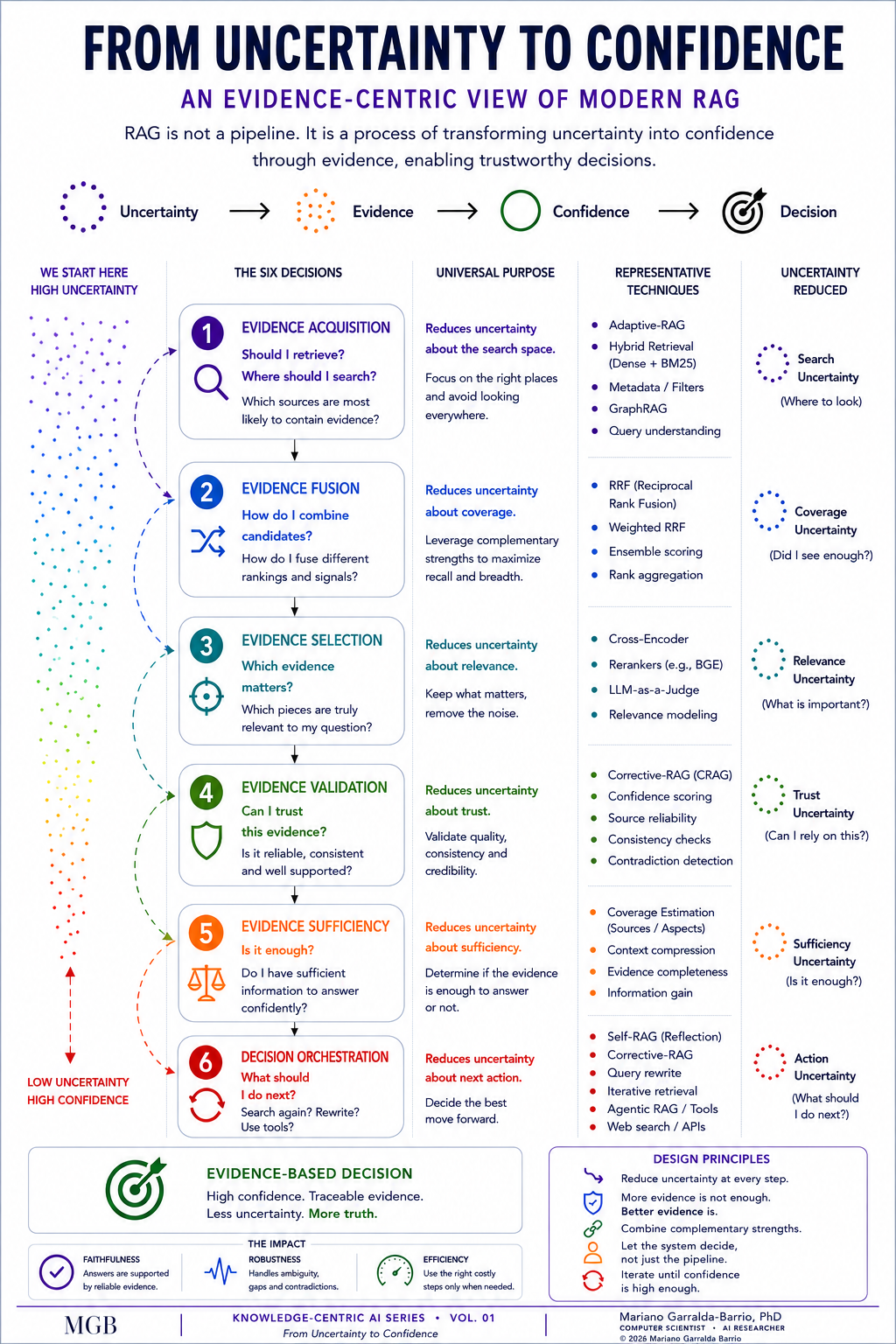
Rather than viewing these architectures as isolated techniques, it proposes that many of them can be understood as complementary mechanisms for reducing different dimensions of uncertainty through progressively stronger evidence.
From this viewpoint, Retrieval-Augmented Generation is no longer simply a retrieval-and-generation pipeline. It becomes an evidence construction process in which each architectural decision increases confidence until sufficient evidence exists to support trustworthy decisions.
The proposed framework organizes modern RAG around six recurring evidence decisions:
Each stage addresses a different source of uncertainty while progressively increasing confidence.
This white paper does not introduce new retrieval algorithms or propose a new RAG architecture.
Its objective is to provide a conceptual framework that helps explain why modern RAG techniques have emerged, what uncertainty each one attempts to reduce, and how they can be interpreted within a unified evidence-centric perspective.